
Introduction
One of the first things Invisalign patients notice isn’t their smile: it’s their aligners.
A few days into treatment, many people ask the same question: “Why do my trays already look cloudy?”
At NEESH Dental, this is one of the most common questions we hear from Saskatoon patients beginning their Invisalign journey. Clear aligners are designed to be nearly invisible, but keeping that seamless look takes a few simple daily habits – and the right cleaning products used at the right frequency.
Unlike traditional braces, Invisalign trays spend up to 22 hours a day in your mouth, sitting in constant contact with saliva, plaque, food residue, coffee, tea, and everything else that happens between breakfast and bedtime. Without a bit of structure to your care routine, they can cloud over, pick up an odor, or develop a yellow tint faster than you would expect.
The good news? Keeping your aligners crystal clear does not require an elaborate or expensive routine. The most effective modern approach combines three things: frequent rinsing, gentle daily brushing with a clear non-abrasive soap, and periodic deeper cleaning with a purpose-made tablet, Invisalign Cleaning Crystals, or an ultrasonic dental pod.
This guide preserves the clinical protocol behind Invisalign Cleaning Crystals while adding a practical comparison of today’s most popular cleaning options. You will also find a realistic seven-day schedule, guidance for stain-prone trays, advice on what products are worth paying more for, and simple habits that help your aligners look as fresh on Day 14 as they did on Day 1.
Why Daily Invisalign Cleaning Is Essential
Think of your aligners like a reusable water bottle: if you used it daily without ever washing it, residue would build up fast. The same thing happens inside your mouth. Wearing a tray for 22 hours a day creates a warm, sealed micro-environment between the thermoplastic and your enamel, and every day it collects:
- Saliva proteins and enzymes that form a thin, sticky film on the plastic.
- Oral bacterial biofilm that thrives in a warm, moist space and contributes to odor and cloudiness.
- Microscopic food particles trapped against your teeth when trays are reinserted before brushing or rinsing.
- Plaque buildup that can harden over time into opaque white or yellow deposits.
- Pigments from coffee, tea, wine, and dark beverages that can collect on scratched or poorly cleaned plastic.
- Mineral deposits from dried saliva that can make an aligner feel rough, look dull, or develop stubborn buildup around its edges.
Skipping your hygiene routine does not just affect how the trays look; it can affect oral health, too. When plaque and food are trapped beneath an aligner, they remain pressed against the teeth and gums for hours. This may contribute to persistent bad breath, localized gum irritation, enamel demineralization, and a higher cavity risk.
Daily cleaning works because it removes biofilm before it has time to dry, mineralize, or absorb stain. Gentle mechanical cleaning with a soft brush loosens residue, while a clear non-abrasive soap provides mild surfactants that help lift oils and film without creating the microscopic scratches associated with toothpaste.
Consistency matters more than intensity. A gentle routine performed every day is safer and usually more effective than allowing heavy buildup to develop and then trying to remove it with harsh chemicals or aggressive scrubbing.
|
CRITICAL WARNING: Avoid Hot Water and Abrasive Toothpastes Never use hot or boiling water to clean your aligners. High temperatures can warp the SmartTrack thermoplastic material and permanently compromise the precise fit your treatment depends on. Avoid whitening, gritty, charcoal, or abrasive toothpastes as well. Their polishing particles can create microscopic scratches that make clear trays look dull and give plaque and pigments more surface area to cling to. |
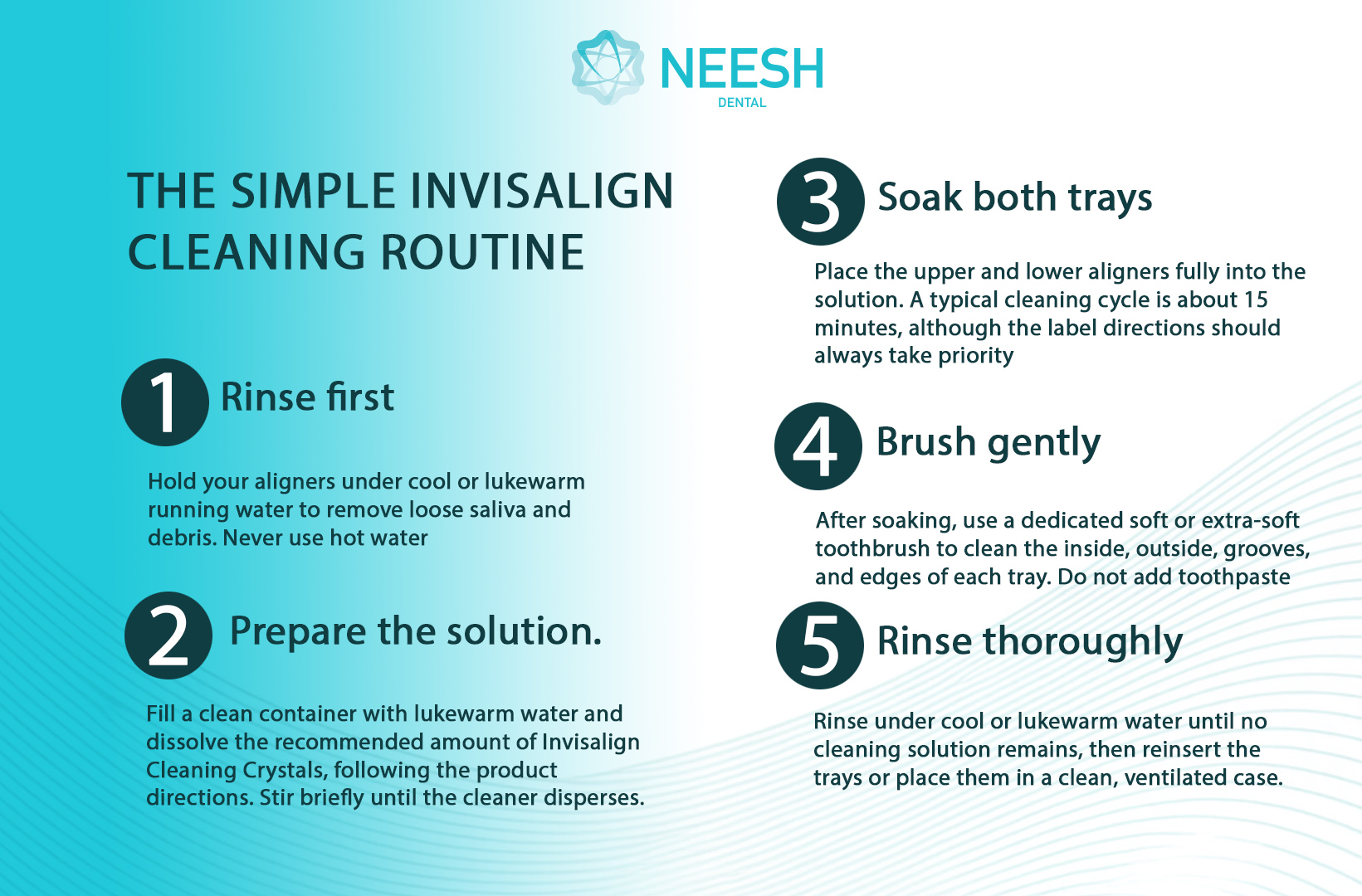
How to Use Invisalign Cleaning Crystals (Step-by-Step)
One of the most common questions we hear is: “Do Invisalign Cleaning Crystals actually work?” The practical answer is yes: they are purpose-made for clear aligners and provide a convenient, standardized soak for loosening plaque biofilm, reducing odor, and maintaining clarity without abrasive brushing.
Most patients do not need Invisalign Cleaning Crystals every day. Two to three deeper cleans per week are generally enough when combined with rinsing at every removal and gentle brushing once or twice daily with clear, unscented liquid soap or mild clear dish soap.
Cleaning Crystals vs. Retainer-Cleaning Tablets
Invisalign Cleaning Crystals and retainer-cleaning tablets perform a similar basic job: both create an effervescent soaking solution intended to loosen deposits, deodorize appliances, and help preserve clarity. The main difference for most patients is not the cleaning concept – it is branding, format, price, and personal preference.
- Invisalign Cleaning Crystals: a recognizable, brand-aligned product made for the Invisalign system. They are easy to standardize in patient instructions and may appeal to patients who prefer an official Invisalign product.
- Retainer-cleaning tablets: pre-measured tablets designed for clear retainers, aligners, and often night guards. Examples include Retainer Brite and similar products. They are usually inexpensive, portable, and simple to use.
For most patients, a reputable retainer-cleaning tablet is a practical, lower-cost option for routine soaking. Cleaning Crystals may be worth the added cost for patients who value the Invisalign brand, prefer the crystal format, or are more likely to follow the routine because the product feels directly connected to their treatment.
A sensible clinic recommendation is to treat tablets as the value option, Invisalign Cleaning Crystals as the brand-aligned upgrade, and either product as an adjunct to – not a replacement for – daily rinsing and gentle brushing.
Ultrasonic Dental Pods: The Modern Hands-Off Option
An ultrasonic dental pod uses high-frequency sound waves to create microscopic bubbles in water. As those bubbles collapse, the resulting cavitation helps dislodge plaque and debris from grooves and small areas that are difficult to reach with a toothbrush. Some models also advertise UV-C sanitation, although features and instructions vary by device.
A typical pod cycle lasts approximately 5 to 10 minutes. Depending on the manufacturer’s instructions, the device may be used with water alone or with a compatible cleaning tablet or solution. The pod should be considered an aid to cleaning rather than permission to skip rinsing, brushing, or good oral hygiene.
Dental pods are particularly attractive to patients who like one-button routines, have difficulty staying consistent with manual soaking, wear long-term retainers or night guards, or tend to develop odor and buildup. They are also reusable for years, but the initial cost is much higher than a bottle of tablets.
Dental Pod vs. Retainer-Cleaning Tablets: Side-by-Side
| Feature | Ultrasonic Dental Pod | Retainer-Cleaning Tablets |
| Cleaning method | Ultrasonic cavitation; some models add UV-C or specialized cycles. | Effervescent chemical soak in cool or lukewarm water. |
| Best strength | Hands-off cleaning of grooves and micro-crevices; consistent one-button routine. | Affordable sanitation and deodorizing with a simple pre-measured dose. |
| Daily effort | Very low once the device is set up: add trays, press the button, rinse afterward. | Low, but the patient must prepare the soak, monitor time, and rinse afterward. |
| Cost | High initial purchase price; relatively low ongoing cost. | Very low upfront and ongoing cost; no device required. |
| Portability | Limited. Requires counter space, power or charging, and transport of the device. | Excellent. Tablets are compact and easy to pack for travel. |
| Heavy buildup | Often helpful as an adjunct because cavitation reaches areas brushing can miss. | May need brushing, more frequent soaking, or professional assessment when deposits are stubborn. |
| Best for | Tech-oriented patients, long-term appliance users, patients who struggle with routine, or those with recurrent buildup. | Most patients, budget-conscious users, frequent travelers, and anyone wanting a simple baseline cleaner. |
| Limitations | Not essential for good hygiene; premium features may not add meaningful value for every patient. | Relies on compliance and thorough rinsing; some patients dislike residual taste if rinsing is incomplete. |
Occasional Targeted Stain Removal
If an aligner develops visible yellowing or odor despite regular cleaning, an occasional stain-focused soak may help. This is not meant to become a daily routine, and any product instructions from your dental team or aligner manufacturer should take priority.
- Diluted hydrogen peroxide: A short soak using equal parts 3% hydrogen peroxide and lukewarm water for approximately 15 to 20 minutes may help lift some discoloration. Brush gently and rinse very thoroughly afterward.
- Diluted white vinegar: A short, diluted vinegar soak may help loosen mineralized deposits. Use it sparingly, rinse completely, and ask your dental team before using it repeatedly.
- Professional assessment: Hard, chalky, rough, or persistent deposits may be mineralized buildup rather than simple stain. If they do not improve with gentle cleaning, bring the tray to your dentist rather than scrubbing aggressively.
Never combine cleaning chemicals, and never use bleach, household disinfectants, undiluted peroxide, or unapproved strong cleaners on an appliance that will return to your mouth.
Best Practices: What to Do – and What to Avoid
The safest routine is built around frequent light cleaning rather than occasional aggressive cleaning. These habits keep the plastic clearer, protect the fit, and make every deeper cleaning method work better.
DO
- Rinse every time you remove your aligners, using cool or lukewarm water so saliva and debris do not dry onto the plastic.
- Brush once or twice daily, using a dedicated soft or extra-soft toothbrush and a small amount of clear, unscented liquid hand soap or mild clear dish soap.
- Brush the inside and outside surfaces, paying special attention to grooves, attachment wells, molar areas, and the edges near the gums.
- Brush and floss your teeth before reinserting trays after meals, so food and sugar are not sealed against the enamel.
- Store aligners in a clean, ventilated protective case, and clean the case regularly with mild soap and cool or lukewarm water.
- Carry a small hygiene kit, including a travel toothbrush, floss, clear soap if practical, your case, and an Orthokey or removal tool.
- Drink only plain water while wearing your aligners, unless your dental team has provided different instructions.
- Follow product contact times, because longer soaking is not automatically better and may leave unnecessary residue or taste.
- Rinse thoroughly after any tablet, crystal, or pod cycle, before the aligners return to your mouth.
DON’T
- Do not use hot or boiling water, because heat may distort the plastic and alter the fit.
- Do not use toothpaste, whitening paste, charcoal paste, or coarse powders, because abrasives can scratch and haze the trays.
- Do not use colored or strongly scented soaps, which may leave a tint, fragrance, or unpleasant taste.
- Do not soak aligners in alcohol-based or colored mouthwash, because alcohol and dyes may affect the appliance or discolor clear plastic.
- Do not use bleach, household disinfectants, or harsh chemicals, and do not combine cleaning products.
- Do not scrub with a medium, hard, or coarse brush, because aggressive bristles increase scratching and cloudiness.
- Do not wrap aligners in a napkin at a restaurant, since this is one of the most common ways trays are accidentally thrown away.
- Do not eat or drink anything other than plain water while wearing your trays, because heat, sugar, acid, and pigment can become trapped against the teeth and plastic.
- Do not leave trays in direct sunlight, a hot vehicle, or near a heat source, whether they are in or out of their case.
A Practical Seven-Day Cleaning Schedule
This schedule combines daily mechanical cleaning with periodic deeper cleaning. It is designed as a practical example rather than a requirement to purchase every product. Patients using only tablets can substitute a tablet soak for pod days; patients using only a pod can follow the device instructions and use a tablet or crystal periodically if compatible.
| Day | Morning and Evening | Deeper Cleaning at Night |
| Monday | Rinse at every removal; gently brush with clear soap. Brush and floss teeth before reinsertion. | Soak in Retainer Brite or another approved retainer-cleaning tablet for the label contact time, commonly around 15 minutes. |
| Tuesday | Repeat the daily rinse-and-brush routine. | Run a 5- to 10-minute ultrasonic pod cycle if using a pod, following the device instructions. |
| Wednesday | Repeat the daily rinse-and-brush routine. | No chemical soak is required. Use thorough brushing or a water-only pod cycle if permitted by the device. |
| Thursday | Repeat the daily rinse-and-brush routine. | Use an approved tablet or Invisalign Cleaning Crystals for a deeper clean. |
| Friday | Repeat the daily rinse-and-brush routine. | Run an ultrasonic pod cycle if using one, then rinse the trays thoroughly. |
| Saturday | Repeat the daily rinse-and-brush routine. | Only if visible staining persists: consider an occasional short, diluted peroxide soak after confirming it is appropriate for your appliance. |
| Sunday | Repeat the daily rinse-and-brush routine and clean the storage case. | No soak is necessary unless buildup or odor indicates one is needed. Focus on careful manual cleaning. |
Adjust the frequency to your needs. Patients who are prone to staining, have long-term retainers, or develop odor quickly may benefit from two to three tablet or crystal soaks each week plus regular pod use. Patients with sensitive mouths or minimal buildup may need less. The non-negotiable foundation remains rinsing, gentle brushing, and clean teeth before reinsertion.
Useful Tools and Materials
- A dedicated soft or extra-soft toothbrush, ideally marked or color-coded for aligners only.
- Clear, unscented liquid soap, with no dye, exfoliating particles, strong fragrance, moisturizer beads, or abrasive additives.
- Invisalign Cleaning Crystals or an approved retainer-cleaning tablet, for periodic deeper soaking.
- An ultrasonic dental pod, for patients who prefer a reusable, hands-off cleaning routine. Use only according to the device instructions.
- A clean, ventilated protective case, plus a second case for work, school, or travel if helpful.
- An Orthokey or aligner-removal tool, which reduces the temptation to pry at a tight tray with fingernails.
- A travel hygiene kit, containing a compact toothbrush, floss, case, and removal tool.
Why Are My Invisalign Aligners Turning Yellow?
Yellowing is almost always caused by habits, residue, or surface changes rather than a flaw in the plastic itself. The most common culprits include:
- Coffee, tea, red wine, and dark beverages, especially when consumed while the trays are in place or when the aligners are reinserted before the mouth is rinsed and cleaned.
- Smoking or vaping, because nicotine, tar, and aerosol residue can leave a yellow-brown film.
- Reinserting trays without brushing first, which traps food particles, sugar, and pigment against both the aligner and the teeth.
- Plaque mineralization, where dried saliva and biofilm harden into white, cream, or yellow deposits.
- Abrasive toothpaste or coarse brushing, which scratches the surface and creates grooves where stain can collect.
- Colored mouthwash or soap, which can tint transparent plastic.
- Improper storage, including leaving aligners exposed on a counter where residue dries or placing them near heat and direct sunlight.
If your trays consistently look yellow, start by reviewing when you rinse, what you drink while wearing them, whether you brush before reinsertion, and whether any toothpaste or colored cleaner is touching the plastic. Most discoloration can be prevented by correcting those habits early.
For mild discoloration, return to the foundation: rinse at every removal, brush gently with clear soap, and add two or three approved deeper-cleaning sessions per week. For persistent yellowing, rough deposits, or odor that does not improve, bring the trays to your dental team. Avoid trying to restore clarity through aggressive scrubbing, prolonged chemical soaking, or household cleaners.
What Are Ortho Munchies and How Do They Help?
Despite the snack-like name, Invisalign munchies – also commonly searched as munchies Invisalign – are not edible. They are small, soft silicone seating aids designed to help press an aligner fully against the teeth.
When you switch to a new tray, tiny air gaps can remain between the plastic and the tooth surface, particularly around attachments or areas where movement is active. Biting down gently and systematically on a Munchy for approximately 5 to 10 minutes a day may help:
- Seat the aligner fully and close visible air pockets between the tray and the teeth.
- Support more predictable tracking by helping the plastic engage the tooth surfaces and attachments as intended.
- Reduce the chance of avoidable refinements when incomplete seating is contributing to tracking problems.
- Ease the pressure of a newly changed tray by helping it settle gradually and evenly into place.
Munchies are a seating tool, not a cleaning tool. Rinse them after use, clean them according to the manufacturer’s instructions, allow them to dry, and store them hygienically. Replace them if they become damaged, sticky, discolored, or difficult to clean.
Orthokey
An Orthokey is a small ergonomic removal tool that hooks onto the inside edge of an aligner, usually near the molars, so you can release a tight tray without digging in with your fingernails.
This can be especially useful during the first days of a new stage, for patients with attachments, or for anyone with short or fragile nails. To use it safely, follow the tool instructions, work gently from one side to the other, and avoid forcefully twisting or bending the tray. Clean and rinse the Orthokey after use and store it in your hygiene kit.
If an aligner repeatedly feels impossible to remove, cracks during removal, or catches around an attachment, ask your dental team to check the fit and your removal technique rather than applying increasing force.
When Should You Contact Your Dentist?
Daily cleaning solves most appearance and odor concerns, but some problems should be assessed rather than managed at home. Contact your dental team if:
- Your tray cracks, splits, or snaps during removal, or an edge becomes sharp enough to irritate the tongue or gums.
- An aligner feels loose, rocks, or no longer fits over your attachments, particularly if there are visible gaps that do not improve with seating aids.
- You notice persistent discoloration, rough buildup, or odor despite consistent rinsing, gentle brushing, and approved deeper cleaning.
- You experience unexpected pain, gum swelling, bleeding, sores, or irritation that does not settle with normal adjustment to a new tray.
- You lose a tray, because you should not automatically jump to the next set or remain out of aligners without advice.
- A tray was exposed to heat, harsh chemicals, or an unapproved cleaner, especially if its shape, smell, texture, or fit seems different afterward.
- You see white spots, sensitivity, or signs that food and plaque are being trapped, since the teeth and gums may need attention in addition to cleaning the aligners.
Do not glue a cracked tray, reshape it with heat, trim it extensively, or attempt to disinfect it with strong household chemicals. Your dentist will decide whether you should continue with the current tray, return to the previous one, move ahead, or arrange a replacement.
Top Invisalign Care Tips from NEESH Dental
- Carry your protective case everywhere. Never place trays loose in a pocket, on a table, or inside a napkin or tray liner.
- Drink only plain water while wearing your aligners. Remove them for coffee, tea, wine, juice, soft drinks, and hot beverages.
- Rinse at every removal and clean morning and night. Frequent light cleaning prevents the buildup that later becomes difficult to remove.
- Use a soft brush and clear non-abrasive soap. Keep a separate toothbrush specifically for the aligners.
- Keep a small hygiene kit with you. Include a toothbrush, floss, case, and Orthokey so you are not tempted to skip cleaning away from home.
- Never expose aligners to hot water or excessive heat. This includes dishwashers, boiling water, hot vehicles, and direct sun.
- Use Invisalign munchies for approximately 5 to 10 minutes a day when advised. This helps trays seat properly, especially after changing stages.
- Use a deeper cleaner strategically. Tablets, Invisalign Cleaning Crystals, or a dental pod can supplement daily brushing two to three times per week or as needed.
- Choose the cleaning option you will actually use. A low-cost tablet used consistently is more valuable than an expensive device that stays in a cupboard.
- Stay consistent with wear time. Wearing your trays for the prescribed schedule – often up to 22 hours a day – is what keeps treatment moving as planned.
Ready for a Straighter, Brighter Smile?
Whether you are just starting to explore the Invisalign treatment process or already partway through treatment, our team at NEESH Dental is here to help you get the most out of every stage.
If your trays are becoming cloudy, yellow, rough, difficult to seat, or hard to remove, bring them with you to your next appointment or contact our Invisalign care team. A quick review of your routine can often solve the problem before it affects comfort, confidence, or treatment progress.
Book your free Invisalign consultation with NEESH Dental, your Saskatoon invisalign experts, today.
Frequently Asked Questions (FAQs)
Can I use toothpaste to clean my clear aligners?
It is best to avoid it. Most toothpastes contain polishing particles such as silica that are designed for enamel. On softer aligner plastic, those particles can create micro-scratches, reduce clarity, and give bacteria and stain more places to collect. Use a soft toothbrush with clear, unscented liquid soap instead.
How often should I use Invisalign Cleaning Crystals?
Two to three times a week is enough for many patients when the aligners are rinsed at every removal and brushed gently once or twice daily. Patients with more staining or buildup may need an adjusted routine, while others may need less. Follow the product directions and your dental team’s advice.
Are Invisalign Cleaning Crystals worth the extra cost over tablets?
For most patients, a reputable retainer-cleaning tablet can provide a similar practical role at a lower cost. Invisalign Cleaning Crystals may still be worthwhile for patients who prefer the official brand, like the crystal format, or are more likely to comply with a product tied directly to their Invisalign treatment. The most important factor is consistent use together with daily rinsing and brushing.
Is an ultrasonic dental pod better than Retainer Brite?
They solve the same general problem in different ways. A dental pod provides a reusable, hands-off ultrasonic cycle and may be helpful for grooves, recurrent buildup, or patients who prefer a one-button routine. Retainer Brite and similar tablets are far less expensive, highly portable, and sufficient for many patients when combined with brushing. A pod is a convenience upgrade, not a requirement for clean aligners.
Can I use a dental pod every day?
Many devices are marketed for frequent or daily use, but the manufacturer’s instructions for the specific pod and the appliance should be followed. Use cool or lukewarm water, avoid unapproved cleaning solutions, rinse thoroughly afterward, and continue gentle manual cleaning because ultrasonic cleaning does not replace brushing your teeth or removing visible film from the trays.
Why are my invisible aligners turning yellow?
The usual causes are coffee, tea, wine, smoking or vaping, reinserting trays over unclean teeth, dried saliva deposits, colored cleaners, or surface scratches from toothpaste and coarse brushing. Correcting the routine early prevents most discoloration.
Can I soak my aligners in mouthwash instead of crystals?
It is best to avoid colored or alcohol-based mouthwash. Alcohol and other ingredients may be too harsh for some appliances, and green or blue dyes can tint clear plastic. Use an approved aligner or retainer cleaner instead.
Can I use denture-cleaning tablets?
Use a product that specifically states it is suitable for clear retainers, aligners, or similar dental appliances. Traditional denture cleaners may be formulated differently and may be too harsh, strongly flavored, or unsuitable for clear thermoplastic. When uncertain, ask your dental team before using it.
Can I use hydrogen peroxide or vinegar?
A short, diluted soak may be used occasionally for stubborn stain or mineral buildup, but it should not replace routine care or become an automatic daily step. Never use undiluted chemicals, never mix cleaning products, rinse extremely well, and confirm with your dental team if you are uncertain about your specific appliance.
What should I do if my aligner cracks or breaks?
Contact your clinic right away. Do not glue it, reshape it with heat, or make major cuts to the plastic. Your dentist will decide whether you should continue wearing it, return to the previous tray, move ahead, or arrange a replacement.
How should I clean my aligner case?
Wash the case regularly with cool or lukewarm water and mild clear soap, rinse thoroughly, and allow it to air dry. Remove visible residue from hinges and corners. Do not place the case in a dishwasher or expose it to high heat unless the manufacturer specifically states that it is safe.
What is the simplest effective routine?
Rinse every time the trays come out. Brush them morning and night with a soft brush and clear soap. Brush and floss your teeth before reinserting them. Use an approved tablet, Cleaning Crystals, or a pod two to three times a week as needed. Avoid toothpaste, hot water, colored soaps, mouthwash soaks, and harsh chemicals.
What is the simplest effective routine?
Rinse every time the trays come out. Brush them morning and night with a soft brush and clear soap. Brush and floss your teeth before reinserting them. Use an approved tablet, Cleaning Crystals, or a pod two to three times a week as needed. Avoid toothpaste, hot water, colored soaps, mouthwash soaks, and harsh chemicals.